Works by this artist

SOLD

Click image to enlarge
|
Jock MacDonald 1897 - 1960 |
|
 |
||||||

Price Codes
Currency: Canadian DollarsCode A
Below $1,000
Code B
$1,000 - $2,500
Code C
$2,500 - $5,000
Code D
$5,000 - $10,000
Code E
$10,000 - $20,000
Code F
$20,000 - $30,000
Code G
$30,000 - $50,000
Code H
$50,000 - $75,000
Code I
$75,000 - $999,999
Add to your profile and receive first notice when new works come available.
The Prices paid for all sold works are confidential. For Priceing details please call us at (250) 537-2421.
Born on May 31, 1897 in Thurso Scotland, Jock Macdonald
contributed a great amount to Canadian Art.
A graduate of the Edinburgh College of Art, Macdonald emigrated to Canada in 1927 to become head of design
and instructor in commercial advertising at the newly-established Vancouver School of Decorative and Applied Arts (now the Emily Carr Institute of Art and
Design). Inspired by the natural environment, Macdonald and his colleague Frederick Varley, head of drawing, painting, and composition, spent much of their
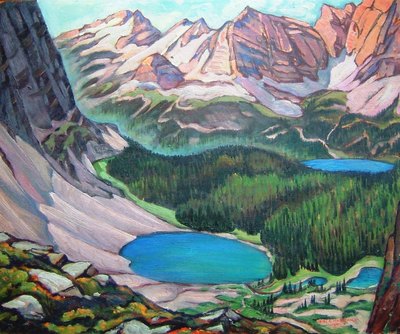
free time on weekends and summer vacations on sketching and camping trips in the Garibaldi Mountains. Macdonald's rendering of the familiar Table
Mountain, O'Hara Lake, Lake Louise, Black Tusk, Castel Towers, and Howe Sound are early representative pieces included in the exhibition along with
other
well-known canvasses such as Lytton Church, B.C., in the collection of the
National Gallery of Canada and Indian Burial, Nootka, in the
collection of the Vancouver Art Gallery.
When the Depression forced severe salary cuts in the art school budget,
Macdonald and Varley decided to
found the B.C. College of Art, in premises on
Georgia Street later occupied by Maynards Auctioneers. It quickly established a reputation as a centre of
new and stimulating ideas in a variety of art forms including music, dance and photography as well as the visual arts. The school operated for two years
before declaring bankruptcy, but its influence on the local cultural community of the period is now legendary.
Macdonald himself was infected by the
exciting ideas fostered at the College
and he began experiments in abstraction. He soon found landscape painting in
the tradition of his Group of Seven
contemporaries too confining whereas
abstraction opened up new vistas of expressive freedom.
During his twenty years in B.C. Macdonald was active as
artist, teacher,
exhibitor, and arts organizer. He was a member of the B.C. Society of Artists, with whom he exhibited regularly, a charter member of the
Federation of Canadian Artists and a member of the Vancouver Art Gallery Council for eleven years, serving on its judging, exhibitions and hanging
committees, and
implementing its popular Saturday morning classes.
The Vancouver Art Gallery accorded Macdonald his first one man show in May
1941
and five years later mounted a solo exhibition, of his "automatic"
watercolours. Macdonald moved to Toronto in 1947 and became instructor of painting
at the
Ontario College of Art. In 1953 he was instrumental in the founding of Painters
Eleven, a group dedicated to the promotion of abstract
art.
He wrote later: "In training young students I believe it absolutely necessary that the student be provided a program of study which forces him to
observe nature very closely in many diverse directions. After some two years of such study I encourage the student to expand his inner self and begin to
expand his personality. I am quite aware that the young student is often intuitively aware of his consciousness of the twentieth century and could create in
modern ways but I believe that every student should, first of all, increase his vocabulary of form and colours by observing nature forms and be initiated
into the laws of balance and dynamic equilibrium."
Macdonald did not reserve the rigours of discipline for his students alone;
Dorothy Hoover
recalls that each summer he would drill his colour sense by
painting flowers from nature, selecting a painting by Georges Braque and
working in its
colour scheme and at one period in his career, subjecting himself to a disciplined work-over such as that offered by Hans Hofmann at his Provincetown
school.
When the Depression forced severe salary cuts in the art school budget,
Macdonald and Varley decided to found the B.C. College of Art, in
premises on
Georgia Street now occupied by Maynards Auctioneers. It quickly established a
reputation as a centre of new and stimulating ideas in a
variety of art forms
including music, dance and photography as well as the visual arts. The school
operated for two years before declaring bankruptcy,
but its influence on the local artists were long lasting, surviving to this day. Jock Macdonald died at the young age of 63 on December 3, 1960.
If you would like additional photos/information or to purchase this item, sell work by this artist or have a question please fill out this form:
 Pegasus Gallery Of Canadian Art: 1-800-668-6131 ~ 250-537-2421 info@pegasusgallery.ca
1-104 Fulford-Ganges Rd. Salt Spring Island, BC, V8K 2S3
Pegasus Framing: 250-931-2122 framing@pegasusgallery.ca
2-111 Robinson Road, Salt Spring Island, BC, V8K 1R6 Canada
2-111 Robinson Road, Salt Spring Island, BC, V8K 1R6 Canada